15 Rug Sizing Secrets Every Homeowner Should Know
1. The Golden Rule: Always Go Bigger Than You Think
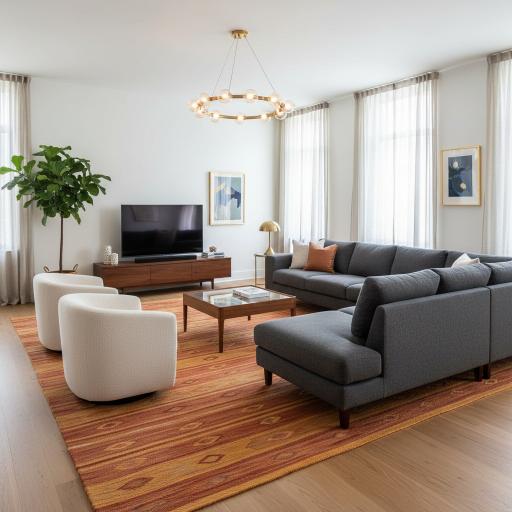
The single most universally applicable and consistently validated rug sizing secret in all of interior design is to go larger than your first instinct suggests, and virtually every interior designer, decorator, and experienced homeowner who has made the mistake of choosing a rug that was too small for a space will tell you that sizing up is the one piece of rug advice they wish they had received and followed from the very beginning. The impulse to choose a smaller rug is understandable and almost universal, driven partly by cost considerations since larger rugs are more expensive, partly by the visual experience of seeing a rug in a shop or online where its scale cannot be properly assessed in relation to actual room dimensions, and partly by a misguided instinct that a smaller rug is safer and less likely to overwhelm a space.
The reality of how rugs function in a room is the precise opposite of this instinct, as a rug that is too small for its space creates a visual effect of spatial fragmentation, making the furniture around it look as though it is floating on disconnected islands rather than being united into a coherent, grounded composition. The correct size rug for a living room should extend far enough under the surrounding furniture for all front legs to rest on its surface, creating a continuous visual field that unifies the seating arrangement and gives the room its sense of spatial resolution and intentional design. Before purchasing any rug, tape out the proposed dimensions on the floor with painter’s tape and live with it for a day to experience the actual scale in relation to your furniture and room proportions.
2. Living Room Sizing: The Front Legs Rule
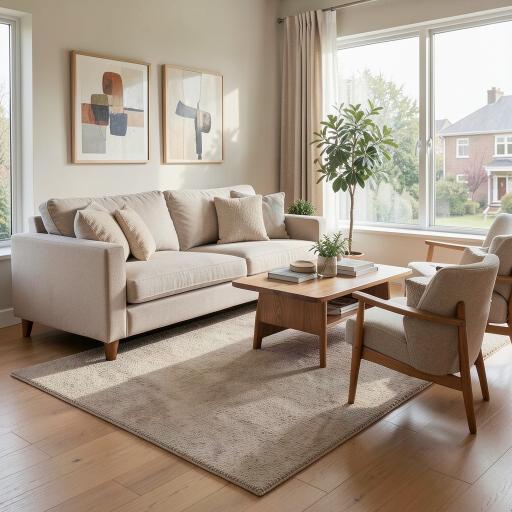
The front legs rule is the most widely taught and practically reliable guideline for sizing a living room rug, and understanding it correctly transforms rug selection from an intimidating guessing game into a straightforward measurement exercise with a clear, predictable outcome. The rule states that the minimum acceptable rug size for a living room seating arrangement is one on which all the front legs of every piece of seating furniture, the sofa, the armchairs, and any additional seats in the primary grouping, can rest simultaneously while the back legs of the same pieces sit off the rug on the bare floor behind. This front-leg-on configuration creates a visual connection between all the seating pieces that anchors them as a unified group without requiring the enormous rug dimensions that a fully all-legs-on configuration demands.
Measuring accurately for the front legs rule requires a clear understanding of your furniture arrangement before you begin rug shopping, as the rug size needed is determined by the footprint of the entire seating group rather than the dimensions of any individual piece within it. Measure from the front of your sofa to the front of the chairs or other seating positioned opposite it, add approximately thirty centimeters on each side beyond the outermost pieces to ensure the rug extends generously past the furniture rather than ending uncomfortably close to its edges, and use this measurement as your minimum rug dimension. In most standard living rooms, this calculation produces a recommended rug size of at least two hundred and forty by three hundred centimeters, which is significantly larger than the two hundred by two hundred and fifty that many homeowners instinctively select as their first choice.
3. The All-Legs-On Approach for Maximum Luxury
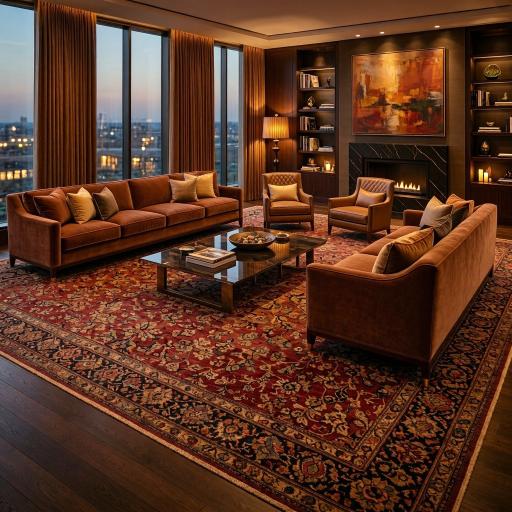
The all-legs-on rug configuration represents the most generous, luxurious, and spatially resolved approach to living room rug sizing, and the rooms that feature this configuration in interior design photography and Pinterest inspiration boards consistently appear larger, more expensive, and more deliberately designed than equivalent rooms where the rug is sized to only accommodate the front legs of the surrounding furniture. When all four legs of every piece of seating in an arrangement rest entirely on the rug surface, the rug functions less as a floor accessory and more as a soft architectural platform, defining the living zone with the clarity and authority of a raised floor level while creating a continuous, uninterrupted surface of warmth and color that extends generously beneath and around all the furniture within the arrangement.
The all-legs-on configuration requires a rug of genuinely generous proportions that most homeowners do not initially consider purchasing, and the cost of a rug large enough to achieve this effect in a standard living room can be significant. However, the visual improvement that the additional rug area provides is consistently and dramatically apparent in the finished room, making the investment one of the most reliably rewarding in all of interior decorating. If budget constraints make a single large rug of the required size prohibitive, layering a smaller decorative rug over a large, affordable natural fiber base rug in jute or sisal creates a version of the all-legs-on effect at a significantly reduced cost while adding the additional visual interest of the layered rug aesthetic.
4. Dining Room Rugs: The Chair Pull-Out Test
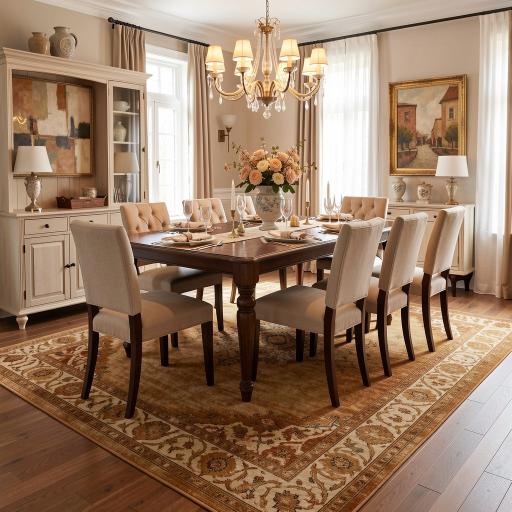
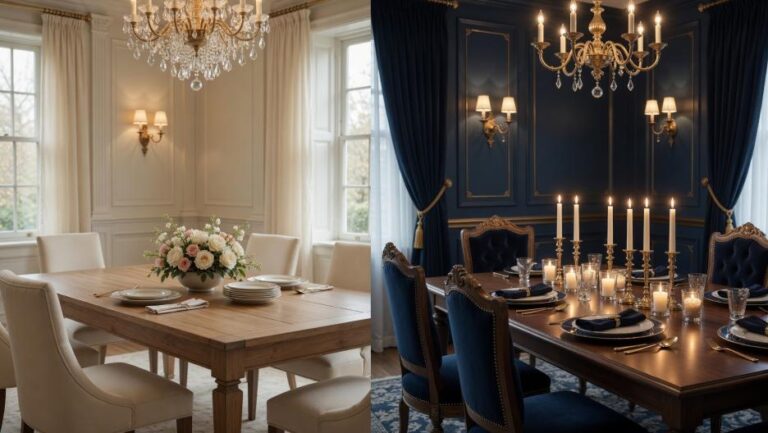
The most critical and most commonly misunderstood aspect of dining room rug sizing is the chair pull-out test, which requires that a dining room rug be large enough for dining chairs to remain fully on the rug surface even when pulled out to the position a seated diner would occupy, typically forty-five to sixty centimeters from the table edge. This requirement is more demanding than it initially appears, because a rug that looks generously proportioned around a dining table with all chairs pushed in may be revealed as significantly too small the moment a chair is pulled back to a sitting position and its back legs drag off the edge of the rug onto the bare floor, creating both a practical hazard of chair instability and an aesthetic disruption of the clean border that a properly sized dining rug should maintain.
The calculation for a correctly sized dining room rug is straightforward once the pull-out principle is understood. Measure the length and width of your dining table, add a minimum of sixty centimeters on every side, and ideally seventy-five to ninety centimeters for a more generous and visually luxurious result, and use these dimensions as your minimum rug size. For a standard rectangular dining table measuring two hundred by one hundred centimeters, this calculation produces a recommended minimum rug size of three hundred and twenty by two hundred and twenty centimeters, which is substantially larger than the two hundred and forty by one hundred and seventy that many homeowners incorrectly select as their dining room rug. Round rugs under round or square tables create a particularly beautiful and cohesive dining room composition when sized generously according to the same pull-out principle.
5. Bedroom Rugs: Frame the Bed Generously
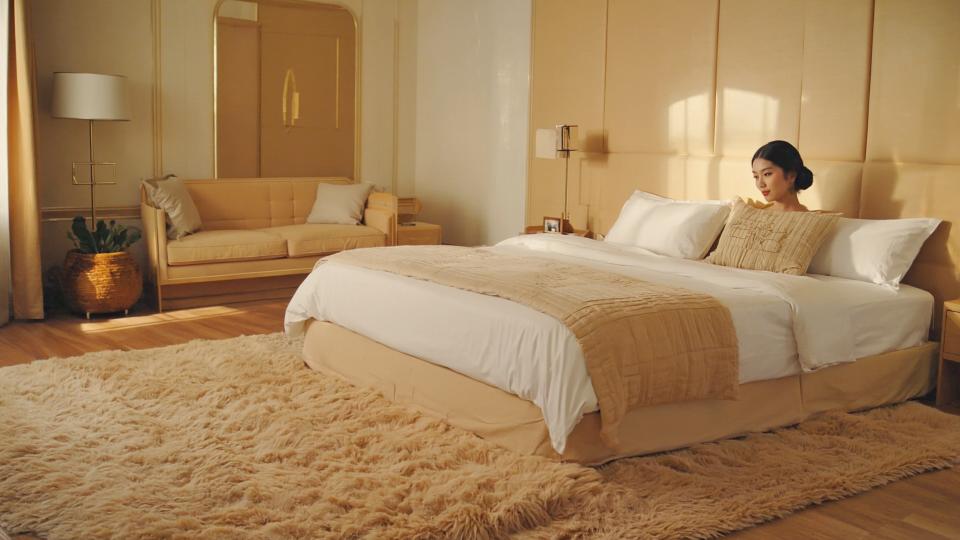
The bedroom rug has a specific and important functional role that is distinct from its purely decorative contribution to the room’s visual quality, and that function is to provide a warm, soft landing surface for bare feet on the first step out of bed each morning and the last step into bed each night. A bedroom rug that is correctly sized for its functional role must extend far enough beyond the sides and foot of the bed for a person standing or walking beside the bed to be fully on the rug surface, which means that the rug needs to project a minimum of sixty centimeters beyond the side edges of the bed and a similar distance beyond the foot of the bed on all three exposed sides.
The visual proportions of a correctly sized bedroom rug are equally important to its functional performance, and a rug that extends generously on all three exposed sides of the bed creates a visual effect of luxury, spaciousness, and careful design intention that a small rug tucked partially beneath the bed cannot achieve. The rug border visible on each side of and below the bed frames the entire bed arrangement in a way that makes the room appear more considered and the bed itself appear more elevated and important within the room’s composition. For a standard king-size bed of one hundred and eighty by two hundred centimeters positioned against a wall, a rug of at least two hundred and forty by three hundred centimeters or larger will provide the generous framing that makes the difference between a bedroom that looks designed and one that merely has a rug.
6. Runner Rugs in Hallways: Length and Width Rules
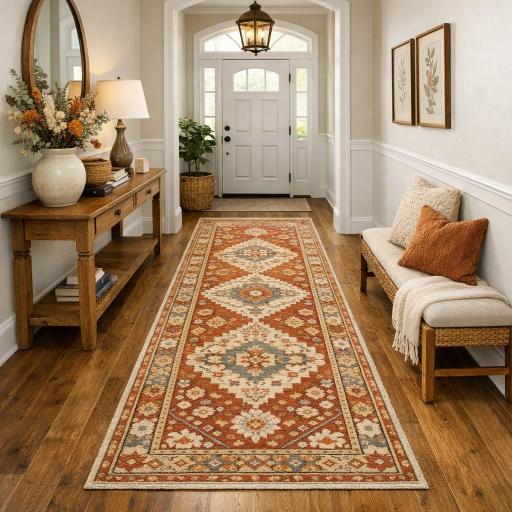
Runner rugs in hallways are one of the most practically useful and visually impactful rug applications in the home, defining the passage through a long corridor, adding warmth and sound absorption to what is typically the hardest-surfaced room in the house, and creating a welcoming first impression of the home from its very entrance point. The sizing rules for hallway runners are specific and important, and getting them right is the difference between a runner that looks deliberately chosen and proportionally correct and one that appears either meanly narrow or awkwardly wide for the space it occupies. The width of a hallway runner should leave a consistent border of bare floor visible on both sides of the rug, typically between eight and fifteen centimeters on each side, which creates the visual impression of a deliberately framed surface rather than a rug that simply fills the available width.
The length of a hallway runner is equally important to its visual success, and a runner that ends awkwardly short of a door, a staircase, or a room opening will always look as though it was purchased in the wrong size for the space rather than chosen with deliberate proportional intention. Run the runner as close as possible to the natural termination points of the hallway, leaving only a small consistent gap at each end for the most resolved and considered result. If a single runner of sufficient length is unavailable or prohibitively expensive, two runners of equal length positioned end to end with a small consistent gap between them creates a coordinated, intentional effect that reads as a design decision rather than a compromise.
7. Use Painter’s Tape to Test Sizes Before Buying
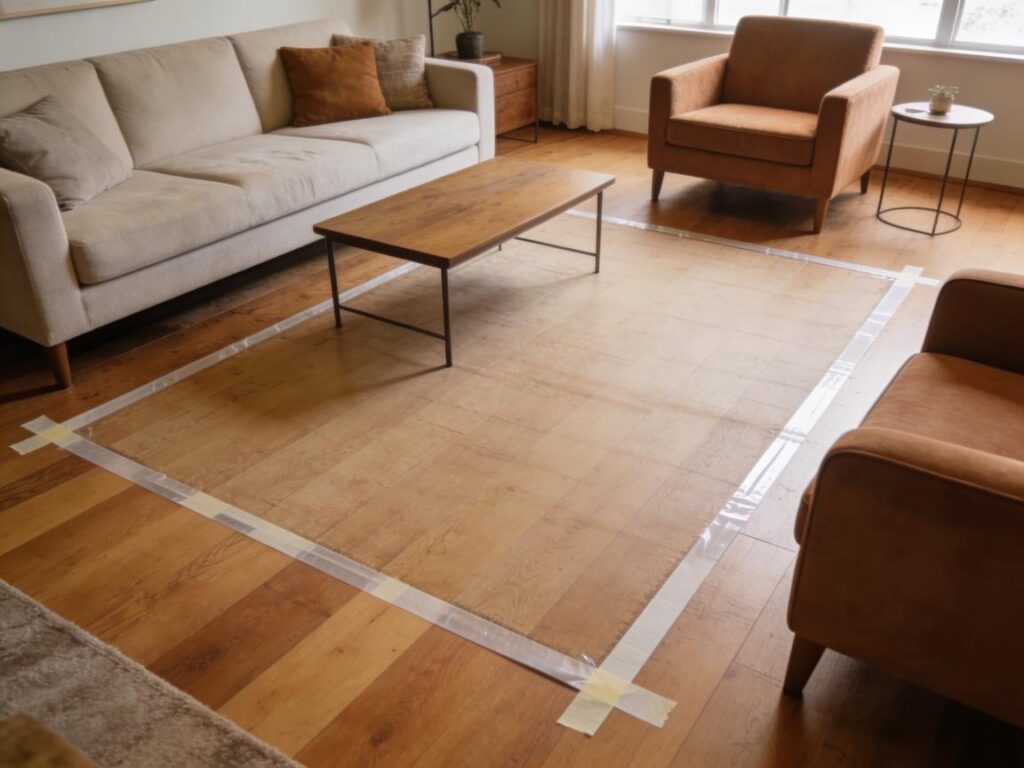
Testing rug sizes with painter’s tape before making any purchase is the single most practical and cost-free piece of rug shopping advice available, and the small investment of time required to tape out your proposed rug dimensions on the actual floor of the actual room saves an enormous amount of money, frustration, and logistical inconvenience compared to the alternative of ordering a rug, having it delivered, unrolling it in the room, and discovering that it is the wrong size for the space. The tape test works by creating a precise, full-size representation of the proposed rug on the floor using blue painter’s tape along all four edges of the intended rug area, after which you can assess the actual scale of the rug in relation to your furniture, room dimensions, and floor proportions with complete accuracy.
Living with the tape outline for twenty-four to forty-eight hours before committing to a purchase is strongly recommended, as the experience of walking around the space, sitting in the furniture, and observing the taped area at different times of day and from different viewpoints within and outside the room consistently reveals proportion issues and sizing adjustments that a single brief assessment might miss. A common discovery during tape testing is that the first proposed size feels too small once it is taped out on the actual floor, confirming the universal principle of going larger than your initial instinct. The tape test also allows you to compare two or three different size options, taping out each one in sequence, before making a final informed decision that you can commit to with complete confidence.
8. Layering Rugs: Size Relationships Matter
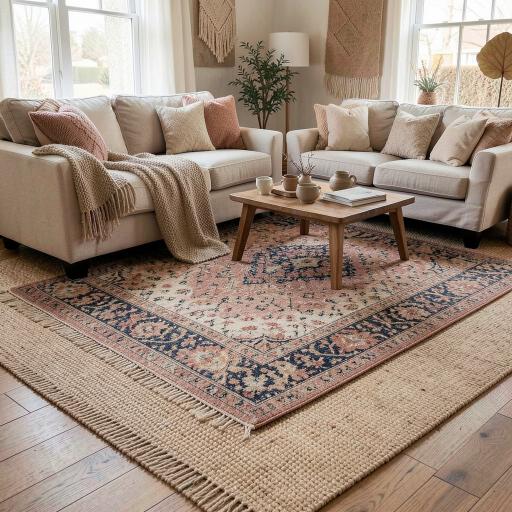
Layering rugs is one of the most creative, budget-friendly, and visually rich approaches to rug decoration available, and understanding the size relationship between the base and top rug is the critical factor that determines whether a layered arrangement looks deliberately designed and beautiful or simply like two rugs that happened to end up on top of each other. The proportional relationship between layered rugs follows a clear and reliable principle: the base rug should be large enough to extend visibly beyond all edges of the top rug by a consistent and generous border, typically a minimum of thirty to forty-five centimeters on each side, so that both rugs are clearly readable as individual elements within the composition rather than the top rug appearing to merely cover the center of the base.
The most successful layered rug combinations pair a large, relatively simple base rug in a natural fiber such as jute, sisal, or a plain flatweave in a neutral tone with a smaller, more characterful and decorative top rug that provides the pattern, color, and cultural interest of the arrangement. The base rug provides the spatial grounding and generous floor coverage that the arrangement requires to look proportionally correct within the room, while the top rug provides the decorative richness and visual interest that a plain base rug alone would lack. Placing the top rug at a slight angle to the base rug, rather than perfectly aligned, adds a casual, spontaneous quality to the layered arrangement that makes it look effortlessly stylish rather than overly considered and formal.
9. Round Rugs: Choosing the Right Diameter
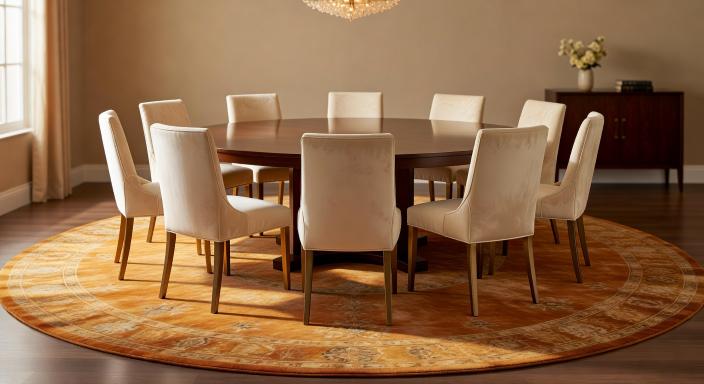
Round rugs are one of the most underused and underappreciated rug formats in residential decorating, and their ability to soften the rectilinear geometry of most rooms, create a sense of defined circular territory within a larger space, and pair beautifully with round dining tables and curved furniture arrangements makes them a genuinely versatile and design-forward alternative to the rectangular rugs that dominate most rug shopping decisions. The sizing rules for round rugs follow the same underlying logic as rectangular ones, the rug must be generous enough to accommodate the furniture arrangement it is intended to anchor with all relevant legs on the surface, but the circular format requires a slightly different approach to measurement that ensures the finished arrangement looks balanced and proportionally resolved from every viewing angle.
For a round dining table, the correct rug diameter is calculated by adding a minimum of one hundred and twenty centimeters to the diameter of the table itself, providing sixty centimeters of rug border on every side for comfortable chair pull-out and visual framing. A round dining table of one hundred centimeters in diameter therefore requires a minimum rug diameter of two hundred and twenty centimeters, with a two hundred and fifty or two hundred and seventy centimeter diameter producing an even more generous and luxurious result. Round rugs also work beautifully as accent rugs in reading corners, beneath circular coffee tables, and at the center of entrance halls, where their contained circular form creates a specific, defined zone of warmth and decoration within the larger floor area.
10. Open Plan Spaces: Define Zones With Rug Size
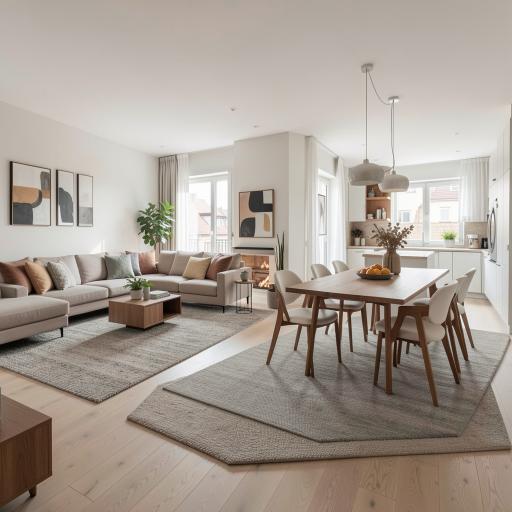
Using rugs of appropriate size to define separate functional zones within an open-plan space is one of the most elegant and effective spatial planning strategies available in interior design, and the correct execution of this principle requires a clear understanding of how each rug’s dimensions relate both to the furniture arrangement it is anchoring and to the overall proportions of the open-plan floor area it is helping to subdivide. Each zone rug must be large enough to contain its associated furniture arrangement convincingly according to the standard sizing rules for that furniture type, while the gap between adjacent zone rugs must be sufficient to provide a clear visual separation between the zones without creating an awkward dead zone of floor that belongs to neither defined area.
The most common open-plan rug challenge is the living and dining space combination, where a living area rug and a dining area rug must coexist within the same undivided floor plan in a way that defines each zone clearly while maintaining a cohesive visual relationship between the two areas. Choose rugs in the same or complementary color families with a consistent tonal relationship to ensure visual cohesion across the two zones, and size each rug according to its own furniture arrangement requirements rather than attempting to make both rugs the same size. A correctly sized living area rug will almost always be significantly larger than a correctly sized dining area rug for a comparable furniture arrangement, and accepting this size difference rather than forcing both rugs to match is essential for achieving proportionally correct results in both zones simultaneously.
11. Small Rooms Benefit From One Large Rug
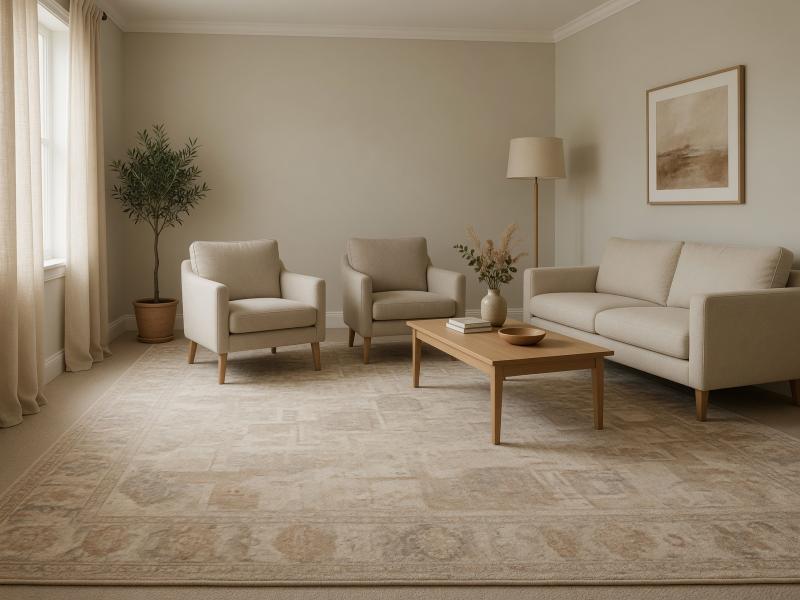
The counterintuitive truth about using rugs in small rooms is that a single large rug that fills most of the available floor area will consistently make the room feel more spacious, more cohesive, and more deliberately designed than a small rug that leaves large expanses of bare floor visible around its perimeter. The psychological mechanism behind this effect is that a large rug creates a continuous, unified floor surface that the eye reads as a single cohesive plane, extending the perceived visual field of the room and reducing the sense of spatial fragmentation and interruption that a small, centrally placed rug creates by dividing the floor into three distinct zones of rug and surrounding bare floor.
In a small room, the ideal rug extends to within twenty to thirty centimeters of every wall, leaving just enough bare floor visible around the perimeter to frame the rug as a distinct surface rather than allowing it to be confused with wall-to-wall carpeting. This generous border of visible floor around a near-room-sized rug creates a clean, architectural edge that makes the room feel deliberately proportioned and professionally considered. The rug color and pattern choice is particularly important in a small room, where a light or medium-toned rug in a subtle pattern or solid color will advance the sense of spaciousness most effectively, while a very dark or densely patterned rug can make an already compact room feel more enclosed and visually heavy than the space requires.
12. Bedroom Runner Placement on Both Sides
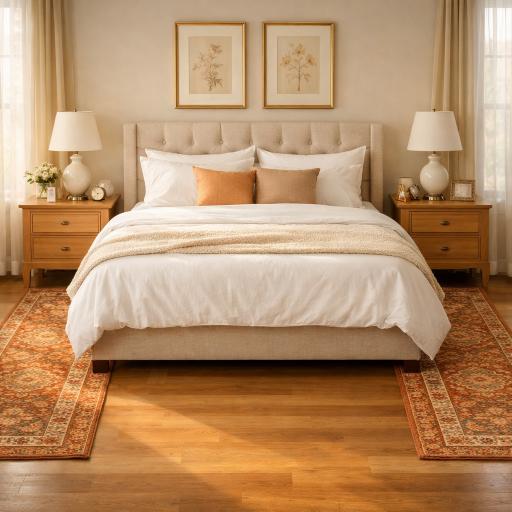
Placing matching runner rugs on both sides of a bed is one of the most elegant and practically effective bedroom rug strategies available, providing warm, soft floor coverage precisely where bare feet land in the morning and evening while maintaining a visual symmetry and intentional arrangement that gives the bedroom a hotel-quality, professionally considered aesthetic. This twin runner approach is particularly well suited to bedrooms where the budget does not extend to a single large rug of the dimensions required to frame the bed generously on all three exposed sides, and it can actually produce a more visually interesting and design-forward result than a standard large rug in rooms where the floor material beneath is beautiful enough to merit being left partially visible.
The sizing of bedroom runners follows specific rules that ensure they look proportionally correct in relation to the bed they are flanking. Each runner should extend from approximately thirty centimeters above the bedside table position to thirty centimeters beyond the foot of the bed, providing coverage along the full length of the sleeping surface and beyond the foot where someone might stand while dressing or making the bed. The width of each runner should be sufficient to provide a soft landing zone of at least sixty centimeters from the edge of the bed frame, with wider runners of seventy-five to ninety centimeters producing a more generous and luxurious result. Choose runners with a low pile for ease of movement around the bed and a consistent tonal relationship with the room’s overall palette.
13. Rug Placement Under Sectional Sofas
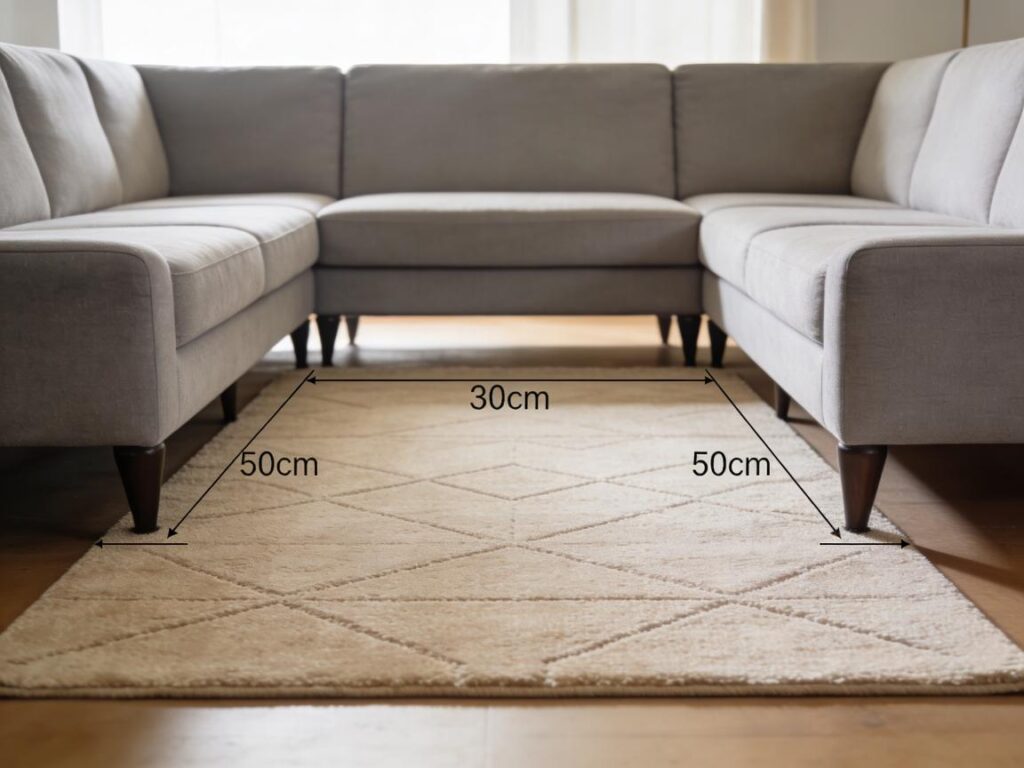
Positioning a rug correctly beneath a sectional sofa is one of the most practically complex rug placement challenges in residential decorating, and the specific configuration of the sectional, whether an L-shape, U-shape, or chaise configuration, determines the correct approach to rug sizing and placement in ways that differ significantly from the simpler task of sizing a rug for a standard sofa arrangement. The fundamental principle remains constant, the rug must extend far enough beneath and around the sectional for all front legs of the primary seating sections to rest on the rug surface, but the irregular footprint of a sectional means that this requirement produces a rug size and placement decision that is more complex to calculate and execute than for a symmetrical furniture arrangement.
For an L-shaped sectional, the rug must extend beneath both arms of the L simultaneously, which typically requires a large square or slightly rectangular rug oriented to align with the corner of the sectional rather than the walls of the room. Position the rug so that it extends at least thirty centimeters beyond the open ends of both sections of the L, ensuring that the rug is visible and functional beyond the terminal points of the furniture rather than ending abruptly at the last leg. The open end of the sectional, where the L configuration does not have a closing arm, requires the rug to extend even further into the open floor area of the room to create a visual balance between the substantial furniture mass of the closed corner and the open end of the arrangement.
14. Rug Borders: How Much Floor to Expose
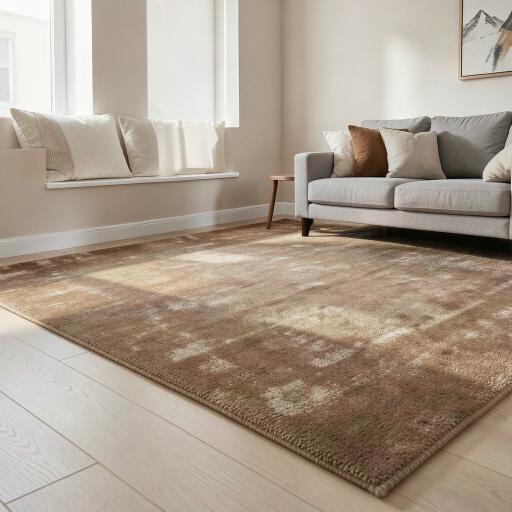
The amount of bare floor left visible between the edge of a rug and the walls of the room it occupies is one of the most important and least discussed proportional decisions in rug placement, and getting this border right is as critical to the visual success of a rug as its overall size and the furniture placement upon it. An insufficient border, where the rug extends too close to the walls and leaves only a centimeter or two of bare floor visible at the perimeter, makes the rug appear to be straining to cover the entire floor and creates an uncomfortable sense of spatial tension and near-miss proportionality that is immediately apparent even without being consciously identified by most observers. An excessive border, where the rug is too small relative to the room and leaves a broad, empty expanse of floor between the rug and walls, makes the room feel spatially fragmented and the rug appear too small, insufficient, and inadequate for the space it is meant to occupy.
The ideal floor border for most living rooms is between thirty and forty-five centimeters of bare floor visible on all sides between the rug edge and the walls, with larger rooms at the higher end of this range and smaller rooms at the lower end. This border width creates a clean, architectural frame around the rug that makes the floor material visible as a deliberate surround rather than an overlooked background, and gives the room a sense of spatial balance and proportional resolution that both too little and too much border consistently fail to achieve. In rooms with particularly beautiful flooring, a slightly wider border of up to sixty centimeters can be used to deliberately showcase the floor material as a design feature in its own right.
15. Replacing Your Rug: When Size Changes Everything
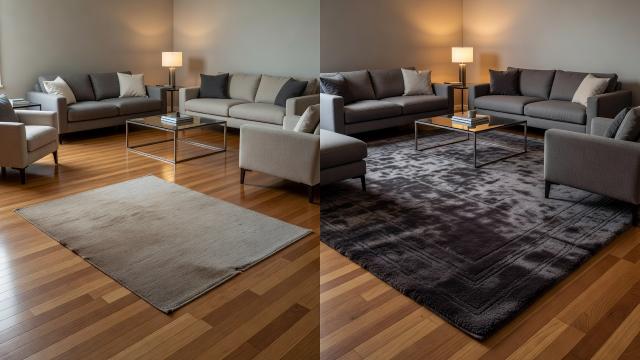
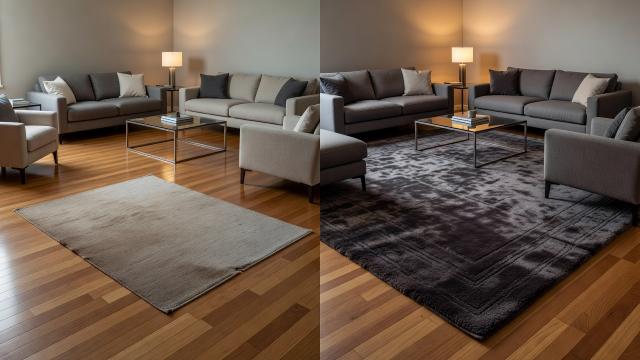
The decision to replace an existing rug with a correctly sized one is often the single most impactful and immediately transformative change you can make to an already furnished room, and the before-and-after contrast between a room with a too-small rug and the same room with a correctly proportioned one is so dramatic that it consistently produces the most astonished and delighted responses of any non-structural home improvement. If you currently live with a rug that you sense is not quite working in its space, that makes the room feel somehow unresolved or smaller than it should, or that causes furniture legs to sit awkwardly at its edges rather than resting comfortably on its surface, the problem is almost certainly one of size rather than color, pattern, or material, and the solution is simply to go larger.
The practical guidance for replacing a rug with a correctly sized one begins with the tape test described earlier in this guide, taping out several potential new sizes on the floor to experience their actual proportions in the real space before committing to any purchase. Measure not just the rug you are replacing but the specific furniture arrangement it needs to serve, calculating the minimum dimensions required by the front legs rule or all-legs-on approach as appropriate for your furniture configuration. If the correctly sized rug is significantly larger and more expensive than you had anticipated, consider the layered rug approach as a cost-effective alternative, or prioritize the rug replacement as a single focused investment that will deliver more visual improvement to the room than any other change at a comparable budget level.